 Brent Schowe, CFA®, Senior Vice President, Director of Research
Credit spreads remain tight, suggesting there has not yet been a broad disruption in the underlying credit environment. However, there are emerging signs of strain beneath thesurface. Credit usage has increased significantly along with interest rates, meaning it is now much more expensive for consumers to borrow.
While the investment-grade segment remains relatively stable and calm, there is increasing stress at the margins, particularly in private credit and certain areas of fixed income. This raises an important discussion point around what stress actually looks like in today’s market and how portfolios should be positioned to withstand a potential shift in conditions.
High-Grade Bond Spreads Start to Widen
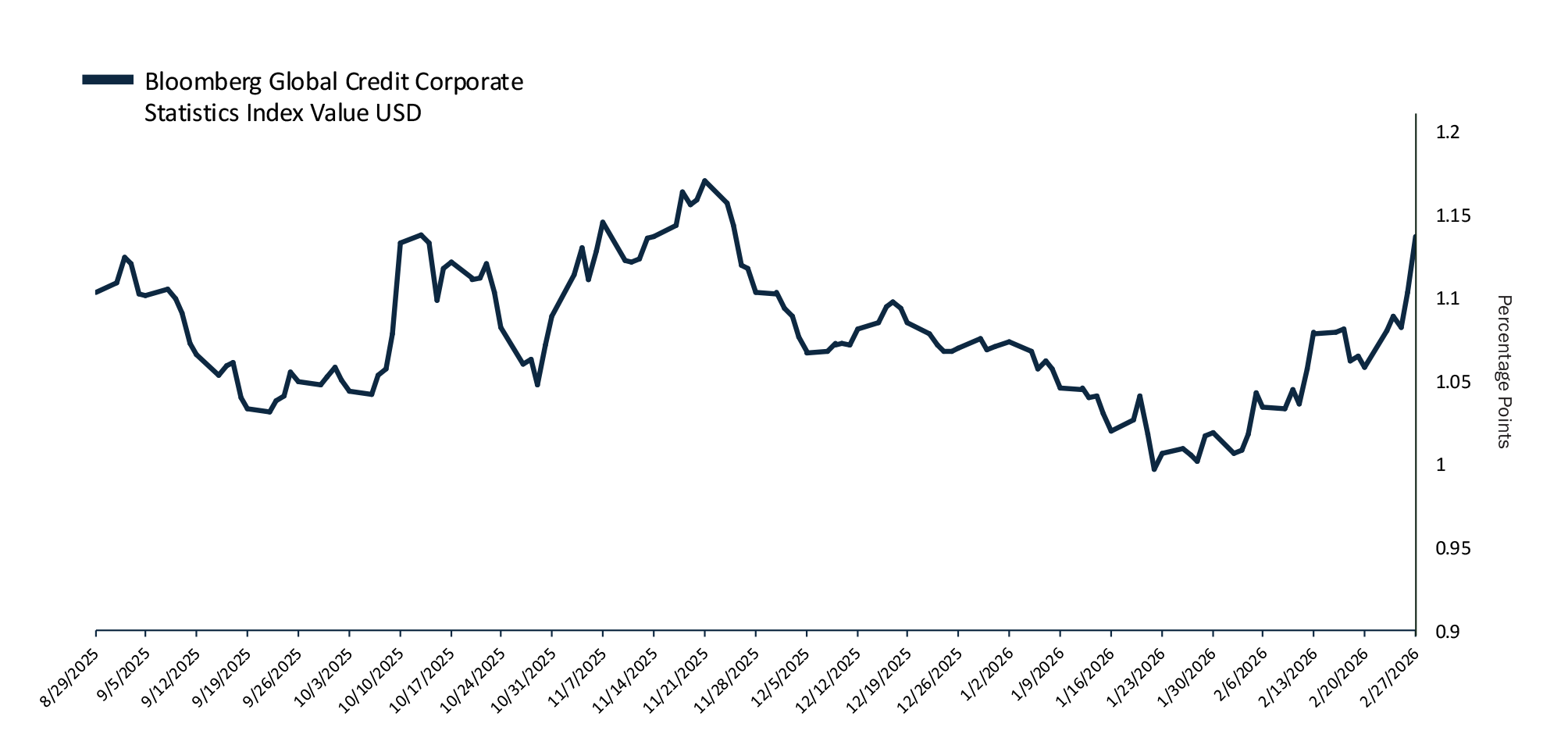
The spike observed in November and December 2025 reflects the market impact surrounding the TriColor failure.
Source: Bloomberg.
Given these early warning signals, the current environment favors moving up in quality to stocks with strong fundamentals and placing greater emphasis on underwriting discipline rather than broadly taking on additional risk. Investors are not fully pulling back from risk yet, but it is an appropriate time to position portfolios more defensively in anticipation of potential volatility.
Recent high-profile failures, including companies like Saks Incorporated, the owner of Saks Fifth Avenue, and Tricolor, an auto-finance company, as well as moves such as Blue Owl Capital executives putting up personal collateral to secure personal loans, highlight underlying weaknesses in credit quality. At the same time, firms such as Apollo Global Management appear to be facing challenges, reinforcing the need to return to a credit-first mindset and scale back exposure to riskier sectors.
These developments also tie into broader economic conditions. The economy is increasingly K-shaped, with lower-income consumers and businesses experiencing greater stress and a higher rate of failure, while more resilient segments continue to perform. Labor market trends reinforce this cautious view, as recent job reports show limited net job growth and an overall environment of stagnation rather than expansion. Together, these factors underscore the importance of proactively managing portfolios with a focus on quality, resilience, and careful risk selection as stress gradually builds within the system.

Past performance is no guarantee of future results, and the opinions and other information in the commentary are as of March 6, 2026. This summary is intended to provide general information only and is reflective of the opinions of Commerce Trust. This material is not a recommendation of any particular security, is not based on any particular financial situation or need and is not intended to replace the advice of a qualified attorney, tax advisor or investment professional.
Diversification does not guarantee a profit or protect against all risk. Commerce Trust does not provide tax advice or legal advice to customers. Consult a tax specialist regarding tax implications related to any product and specific financial situation. Data contained herein from third-party providers is obtained from what are considered reliable sources. However, its accuracy, completeness or reliability cannot be guaranteed.
The Chartered Financial Analyst® (CFA®) Charter is a designation granted by CFA Institute to individuals who have satisfied certain requirements, including completion of the CFA Program and required years of acceptable work experience. Registered marks are the property of CFA Institute.
Commerce Trust is a division of Commerce Bank.
Investment Products: Not FDIC Insured | May Lose Value | No Bank Guarantee