 David Hagee, Executive Vice President, Chief Investment Officer

As markets hover near the upper end of historic valuation ranges and global uncertainties accelerate, the balance of risks is shifting, and heightened volatility is likely to remain a defining feature of the investment landscape in 2026.
Investing in equities offers the potential for higher returns than other asset classes but also comes with some expected volatility and the possibility of losses. Sorting the market into periods based on how expensive stocks are can provide useful context for understanding historic drawdowns and intra-year market declines. Measured by price-to-forward earnings (P/E), valuations are categorized as cheap when they are below 16 times earnings, moderate at 16 to 20 times earnings, elevated at 20 to 24 times earnings, and stretched or extreme above 24 times earnings. Currently, the S&P 500 Index is at approximately 24 times earnings and is fluctuating between the elevated and stretched valuation ranges. Periods marked by higher valuations typically feature heightened volatility.
Volatility and Valuations
Source: Bloomberg, Shillerdata.com.
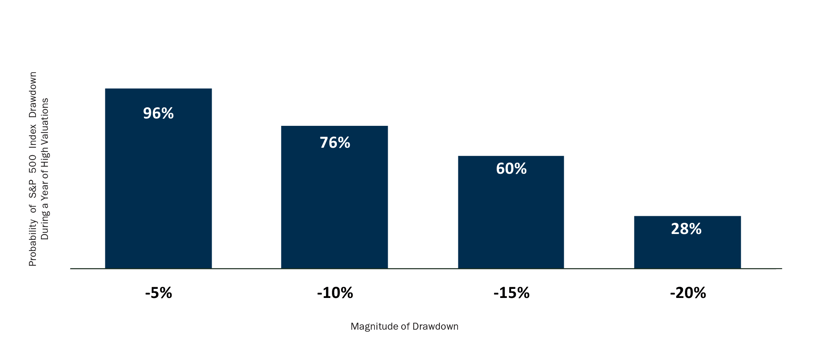
Historically, the probability of a five percent market correction in any given year is 96 percent, while a 10 percent intra-year decline occurs 76 percent of the time. These levels of volatility are common across most valuation environments, but in the higher valuation tiers, the likelihood of deeper pullbacks increases. The probability of a 15 percent decline rises to 60 percent, and the probability of a 20 percent decline increases to 28 percent.
Markets can become more fragile as greater earnings growth is priced in, making them more sensitive to disruptions in fundamentals or changes in broader economic expectations. Disruptions have been numerous and fast moving in 2026. For example, assumptions supporting earnings power in the technology sector are being challenged as advances in artificial intelligence challenge traditional software business models. The conflict in Iran presents a broader macroeconomic risk, largely because rising energy prices have slowed global economic activity, creating pressure in the energy-dependent world economy.
Given current valuations and significant geopolitical uncertainty, we expect volatility to remain elevated. Despite challenges, U.S. corporate earnings continue to demonstrate resilience. Over the intermediate and long term, earnings remain the primary driver of equity market performance. These conditions highlight the importance of active portfolio management with an emphasis on quality, resilience, and selective risk-taking as stress gradually builds within the economic system.

Past performance is no guarantee of future results, and the opinions and other information in the commentary are as of April 1, 2026. This summary is intended to provide general information only and is reflective of the opinions of Commerce Trust. This material is not a recommendation of any particular security, is not based on any particular financial situation or need and is not intended to replace the advice of a qualified attorney, tax advisor or investment professional.
Diversification does not guarantee a profit or protect against all risk. Commerce Trust does not provide tax advice or legal advice to customers. Consult a tax specialist regarding tax implications related to any product and specific financial situation. Data contained herein from third-party providers is obtained from what are considered reliable sources. However, its accuracy, completeness or reliability cannot be guaranteed.
Commerce Trust is a division of Commerce Bank.
Investment Products: Not FDIC Insured | May Lose Value | No Bank Guarantee