 Tara McConkey Director of Portfolio Management – East Region

Equity markets are keeping a close eye on artificial intelligence (AI)
A third of the S&P 500 Index is made up of AI and AI-adjacent companies. Since 2022, the market capitalization of the S&P 500 has risen about $21 trillion. Of that, 55% was due to the top ten stocks in the index including Microsoft, NVIDIA, and Broadcom. The Magnificent Seven alone accounted for 43.1% of returns.
S&P 500 Index Annualized Returns
Magnificent Seven portfolio driving returns
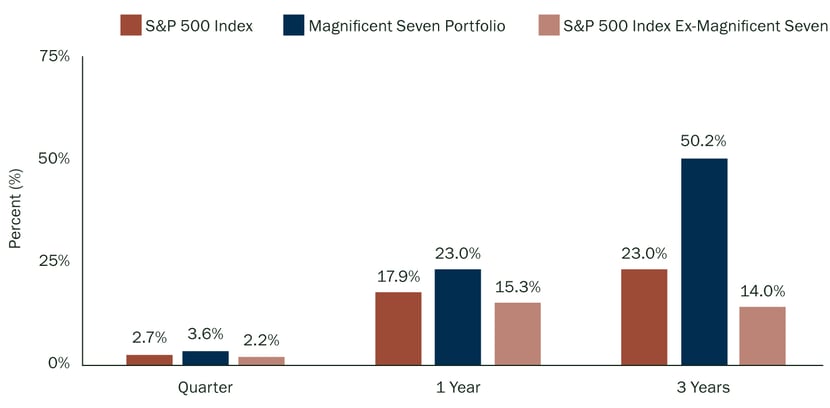
Source: Factset (SPX Annualized Returns, through 12/31/2025)
AI has already made major inroads in a broad range of sectors from healthcare and finance to entertainment and transportation. AI is in autonomous vehicles, and is used for investing, data integration, and predictive analysis.
Not another dot-com bubble
With rapid growth of this new technology, the question of a bubble, like the dot-com bubble in the late 1990’s
and early 2000’s, is top of mind.
During the internet boom, the technology’s infrastructure was weak and expensive. Many companies during this time produced no sustainable revenue, no profitability, and vague business models. In contrast, AI technology is already powerful and widely deployed, with strong revenue growth.
AI is still in foundational stages. The next advancement technologies are still being developed. The excitement around and investment in AI has just started. Currently, AI stock prices are nowhere near the price to earnings ratios experienced during the internet boom era.
|
Bubbles: A boom and bust cycle Historically, stock market or investment bubbles follow a cycle of five stages. First, a new development sparks investor interest. Second, as capital flows into the new asset, prices begin to rise. In the third stage, excitement ramps up and investment continues as the general public joins in. As demand increases, prices rise. In the fourth stage, early investors recognize inflated prices and view them as unstable and start to sell off investments. This selling can point to a peak and create market volatility. Finally in the fifth stage, the unstable and inflated prices are vulnerable to market events or news that can influence a mass exodus of sellers and, in turn, cause the bubble to burst. Investors who entered near the peak are likely to see significant financial losses after the bubble has burst. |
Price to Earnings Growth Comparison: Cisco and NVIDIA
Current valuations remain disciplined compared to internet boom
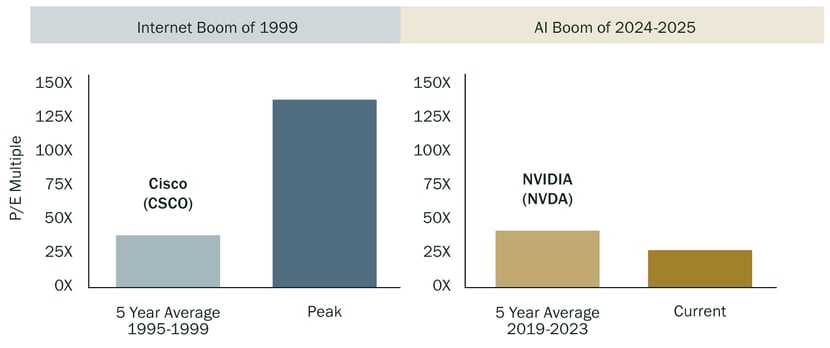
Source: Coatue, Bloomberg (Price to Earnings Growth Comparison), Cisco peak March 2000, NVIDIA current through 10/31/2025
Strong fundamentals and competitive demand
AI stock prices appear to be supported by solid fundamentals and cash flow. The valuation of NVIDIA still appears to be supported by fundamentals and even considered undervalued by some given its current growth rates. Compared to Cisco’s price-to-earnings ratio in the late 1990s, NVIDIA is not in a boom at all, but experiencing strong, consistent growth.
During the dot-com era, utilization rates on fiber optics built for the internet were around 20-30%. Supply was
outpacing demand. Currently, utilization rates of data centers built for AI are over 80%1, pointing to comparatively stronger supply and demand for AI technology and infrastructure.
Productivity is the real return on investment
Productivity is at the core of return on investment for AI. With AI tools, corporations are able to manage information and run operations at a much faster pace with less human labor, resulting in reduced costs for the same output. AI will take years to be fully implemented. Productivity gains differ by occupation and industry. Some economists suggest the long-term impacts of AI could increase GDP by 1.5% by 2035.2
Technology adoption soars
ChatGPT launched in 2022, introducing the average consumer to a vast new resource. In the three years since its launch, the technology has already advanced remarkably. What started as a basic chatbot has evolved into a tool for a variety of things from fraud-detection and providing customer service to helping medical professionals diagnose diseases and set up treatment plans.
Consumers are adopting AI tools at a much faster pace than other app-based tools and technology. When the
Microsoft Internet Explorer browser was launched in 1995, it took five years to reach 100 million users. Facebook reached 100 million active users around four-and-a-half years after its launch. Instagram took three-and-a-half years to reach similar adoption. ChatGPT reached 100 million active users in a fraction of that time, in just two months.
Energy sector gets an AI boost
AI requires an enormous amount of energy. A high-end NVIDIA AI chip can use almost as much energy as an average American home. Building a data center is the energy equivalent of building a small town. This makes energy stocks very interesting. As a result of the increase in data centers, energy prices are trending up, along with commodities. Utility companies are becoming more valuable as data centers are growing.
Average Electricity Growth by Decade
AI technology is energy intensive
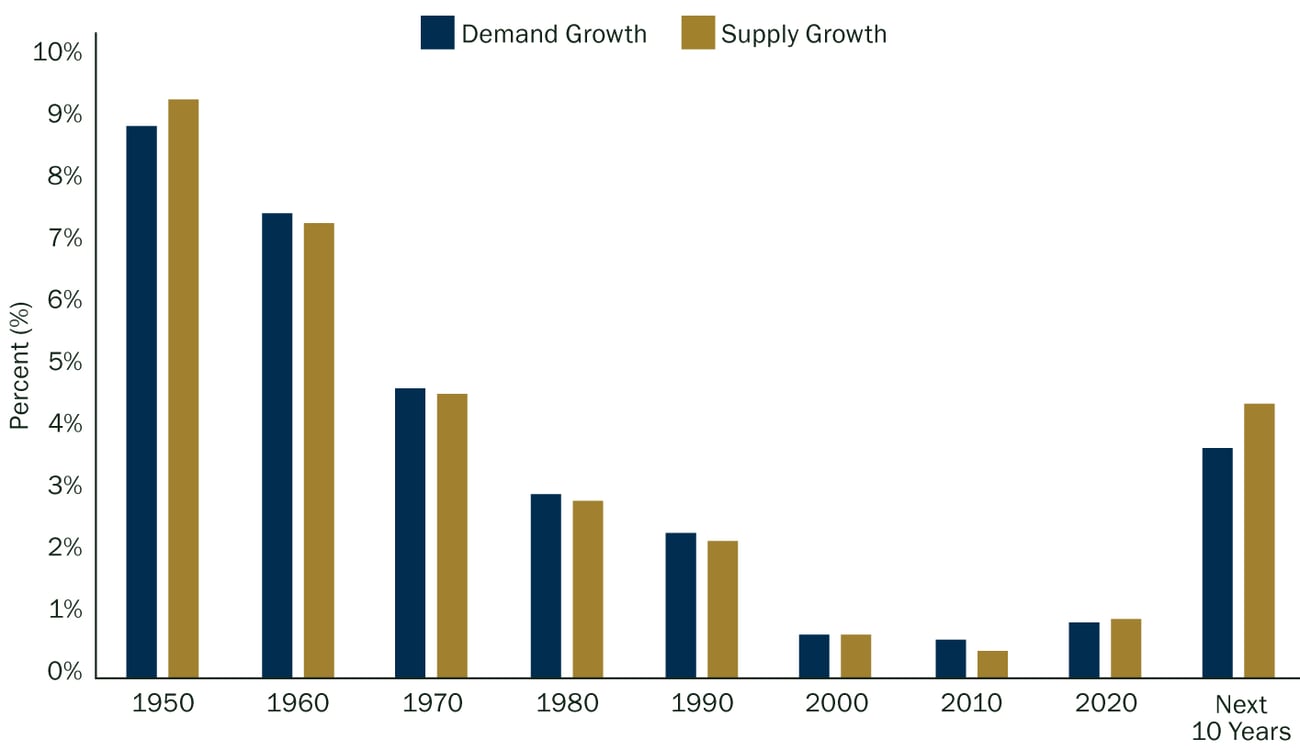
Source: Energy Information Administration.
Infrastructure and data center investments
Companies are focusing their AI investments in two places, infrastructure and data centers. The cloud is a global network of remote servers accessed via the internet to provide on-demand computing services such as storage, databases, and software. The cloud is used in place of relying on local hardware. The cloud is a typical infrastructure starting point for companies as it is scalable and efficient with a lower up-front cost due to its pay-as-you-go structure. But it comes with downsides, mainly the ongoing cost to maintain the cloud and data privacy. Some companies are taking a hybrid approach with in-house infrastructure to protect their data in addition to using cloud-based tools.
Looking ahead
The AI of the future will likely be smarter, faster, and more intuitive, potentially transforming every aspect of life, business, and industry. AI has the potential to evolve to understand humans, adapt to our habits, preferences, and possibly human emotions instantaneously. AI may be able to anticipate needs and act like a personal assistant, predict illness and disease, even create music and art. AI is positioned to adapt knowledge and learn new tasks, with reasoning closer to human thought.
The AI cycle is supported by strong fundamentals. Selectivity with respect to AI or AI-adjacent investment
opportunities remains critical, but reasonable valuations and earnings growth point to a market driven more by monetization than speculation.

1 T. Rowe Price
2 The Wharton School of the University of Pennsylvania
Past performance is no guarantee of future results, and the opinions and other information in the commentary are as of February 11, 2026. This summary is
intended to provide general information only and is reflective of the opinions of Commerce Trust. This material is not a recommendation of any particular security,
is not based on any particular financial situation or need and is not intended to replace the advice of a qualified attorney, tax advisor or investment professional.
Diversification does not guarantee a profit or protect against all risk. Commerce Trust does not provide tax advice or legal advice to customers. Consult a tax
specialist regarding tax implications related to any product and specific financial situation. Data contained herein from third-party providers is obtained from what
are considered reliable sources. However, its accuracy, completeness or reliability cannot be guaranteed.
Commerce Trust is a division of Commerce Bank.
Investment Products: Not FDIC Insured | May Lose Value | No Bank Guarantee