 David Hagee, Executive Vice President, Chief Investment Officer

Hosting a FIFA World Cup™ can provide a short-term boost to a local economy, but the longer-term impact often depends on where and how the tournament is hosted.
World CupTM Effect on Market Returns
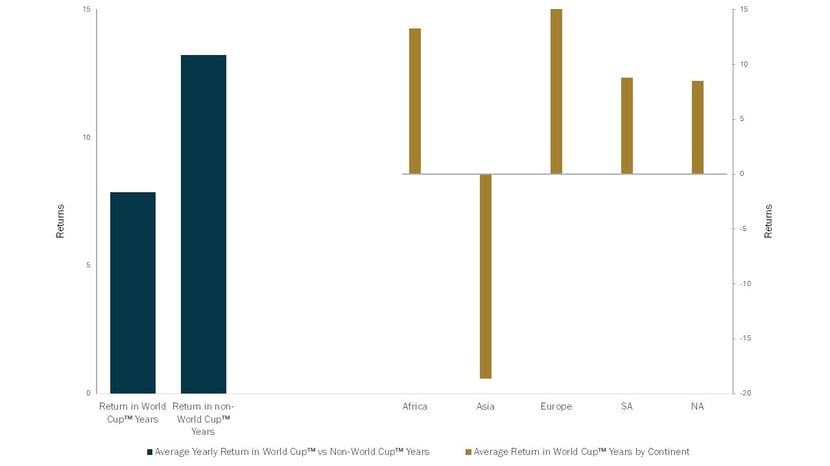
Source: Bloomberg, Sahm Capital.
In the lead up to the tournament, host cities typically see increased spending on infrastructure, hospitality, transportation, and tourism. Consumers pay a premium for hospitality services from hotels and restaurants to rental cars and rideshares, as demand far exceeds supply for the concentrated duration of the events. Local businesses see a boost from both the volume and premium upcharges. Retailers also benefit from higher foot traffic, and temporary employment rises. Then much of the spending during the event itself shifts toward consumption of disposable goods, such as food, beverages, and merchandise. The economic boost tends to be temporary, rather than investment in long-term, productive, income-generating assets.
However, this shift in consumption patterns can influence the economy in the year that follows. Because spending is concentrated on short-lived goods rather than long-term capital formation, some host countries experience a slowdown in gross domestic product (GDP) growth after the tournament. Whether that deceleration is directly caused by the event or simply coincidental is not clear, as broader macroeconomic forces often play a larger role than the tournament itself.
Whether the economic legacy of hosting the World Cup™ is positive ultimately hinges on if infrastructure investments create lasting productivity gains or become underutilized assets. FIFA World Cup 26™ is the first to be hosted across three different countries, Canada, the United States, and Mexico. This year’s is one of the most geographically dispersed tournaments, which means the economic impacts may be dispersed as well.
A broad economic boost from tourism and leisure spending is expected to be felt throughout the host countries. Global beer sales are expected to grow by 6% to 10%, breaking a recent slump of declining beer sales. A stunning 16.7 million beers are expected to be sold in stadiums alone with global World Cup™ consumption of beer anticipated to be approximately 14.4 billion beers[1].
Interestingly, financial markets have also been known to display subtle patterns during World Cup™ periods. While no clear causal relationship has been established, global markets have historically appeared somewhat less volatile during tournament months. When hosted in Asia, for example, Asian equity markets have at times underperformed while other regions posted gains. These tendencies are more observational than predictive, but they highlight how global attention, investor sentiment, and capital flows can shift, at least temporarily, during major international events.
[1] Source: ProBrewer, Jefferies

Past performance is no guarantee of future results, and the opinions and other information in the commentary are as of April 1, 2026. This summary is intended to provide general information only and is reflective of the opinions of Commerce Trust. This material is not a recommendation of any particular security, is not based on any particular financial situation or need and is not intended to replace the advice of a qualified attorney, tax advisor or investment professional.
Diversification does not guarantee a profit or protect against all risk. Commerce Trust does not provide tax advice or legal advice to customers. Consult a tax specialist regarding tax implications related to any product and specific financial situation. Data contained herein from third-party providers is obtained from what are considered reliable sources. However, its accuracy, completeness or reliability cannot be guaranteed.
Commerce Trust is a division of Commerce Bank
Investment Products: Not FDIC Insured | May Lose Value | No Bank Guarantee